Which models Kling AI carries
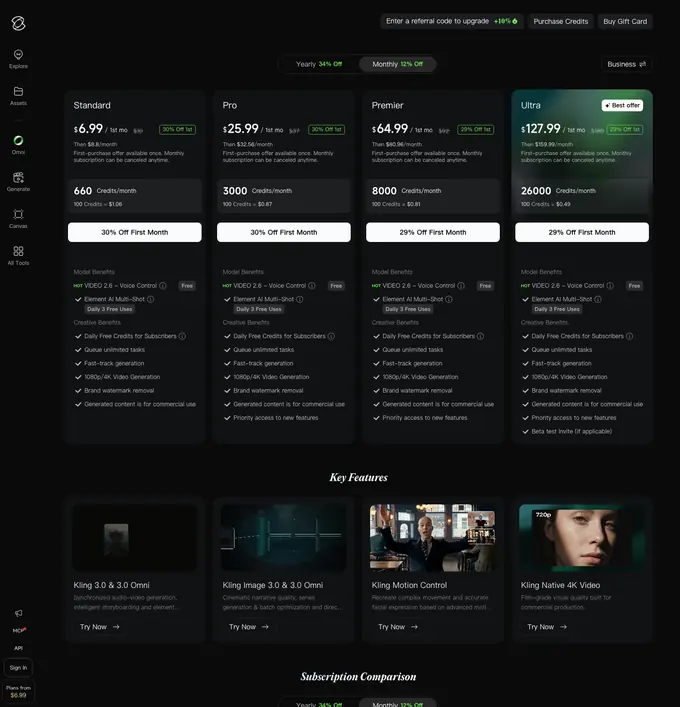
Kling AI (kling.ai) runs two generations at once: Kling 3.0 and 3.0 Omni are promoted as the current models while VIDEO 2.6 still appears as a plan benefit, so a subscriber is buying access to both. As of 2026-09-12.
| Model | Whose model | Announced end |
|---|---|---|
| Kling 3.0 | In house, current | No date announced |
| Kling 3.0 Omni | In house, current | No date announced |
| VIDEO 2.6 | In house, previous generation | No date announced |
Inclusion rule. Models the app names on its own public pages. A model the app does not name is not listed, and an end date is recorded only when the vendor that makes the model has announced one. Order. As the app orders them on its own page.
1How many models each application names
| Entry | Rows it publishes |
|---|---|
| Adobe Firefly | 5 rows |
| Amazon Bedrock | 3 rows |
| fal | 4 rows |
| Gemini API | 5 rows |
| Hailuo AI | 1 row |
| invideo AI | 5 rows |
| Kling AI | 3 rows |
| LTX Studio | 4 rows |
| Luma | 6 rows |
| Microsoft Foundry | 2 rows |
| Pika | 1 row |
| PixVerse | 4 rows |
| Runway | 5 rows |
| SceneMixer | 5 rows |
| Vidu | 2 rows |
| Wan-AI | 5 rows |
Inclusion rule. Entries whose own pages name a model, a version identifier or a lifecycle state. House tier names with no model behind them are not counted. Order. Alphabetical by entry name.
| Entry | Rows with an announced end |
|---|---|
| Adobe Firefly | 1 announced |
| Amazon Bedrock | 3 announced |
| fal | 1 announced |
| Gemini API | 5 announced |
| Hailuo AI | 0 announced |
| invideo AI | 1 announced |
| Kling AI | 0 announced |
| LTX Studio | 0 announced |
| Luma | 1 announced |
| Microsoft Foundry | 2 announced |
| Pika | 0 announced |
| PixVerse | 0 announced |
| Runway | 0 announced |
| SceneMixer | 0 announced |
| Vidu | 0 announced |
| Wan-AI | 0 announced |
Inclusion rule. Counted only where the vendor that makes the model has announced a date in public. A date reported by press coverage alone is not counted. Order. Alphabetical by entry name.
2Two generations on one plan is a migration path by accident
Nothing on the membership page describes a migration policy, and yet the effect of listing an older generation alongside a newer one is the same: a production that started on the older model is not forced forward the day the newer one ships. Whether that is a commitment or a transitional state is not stated anywhere.
That distinction decides how much weight a studio should put on it. A published policy survives a product decision; a model that merely still appears in a benefit list does not, and the list can be edited without an announcement.
3What a benefit list does not tell you
A plan table names models; it does not say when one arrived, when another will leave, or whether output generated on a version stays reproducible after that version goes. For serial work the last of those is the one that matters, because an episode regenerated on a newer model is a continuity problem rather than an upgrade.
No end date is announced for any row on this page, which is the normal state for an application in this register rather than a distinction. Published dates exist here only where a model maker or a hosting platform issued them, and the calendar holds all of them.
4Read column by column
This register reads Kling AI along named replacement, default tier and lifecycle states. One page each.
- Named replacement — two generations on one plan, with neither marked as the route off the other
- Default tier — two generations on one plan, with the newer pair promoted but nothing marked as default
- Lifecycle states — current and previous generation function as states without being published as any
5Sources
Menu taken from the membership plans on kling.ai, 2026-09-12. Any end date beside a model comes from whoever makes it, and is listed on the calendar.